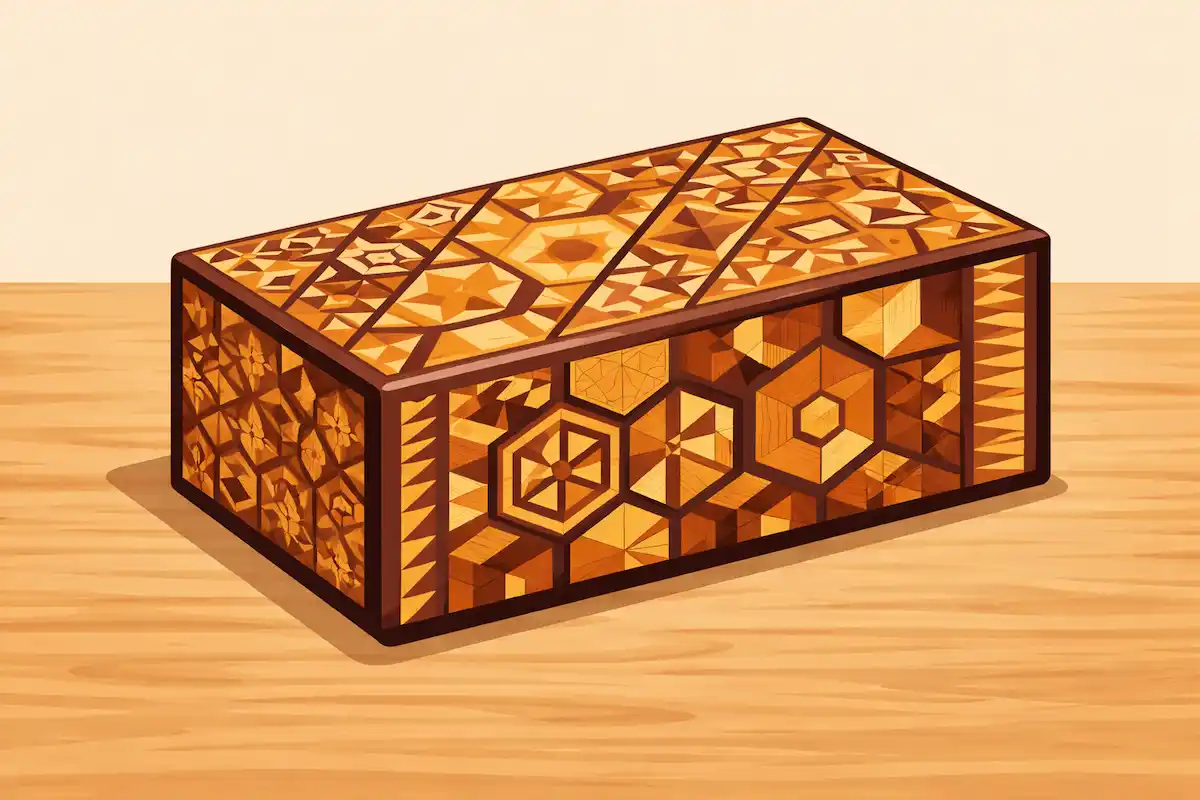
寄木細工を英語で説明・紹介するための基本情報と、英会話に役立つ表現をシンプルでわかりやすい英語で紹介します。
英会話ダイアローグ・概要・10の質問を通して、寄木細工に関する英語表現を学びます。
英語
英会話ダイアローグを読む前に知っておくと良い前提知識と情報です。
- 寄木細工とは
色や木目の異なる天然木を組み合わせて模様を作る伝統的な木工工芸
塗料や染料は使わず、木そのものの自然な色だけで模様を表現 - 歴史的背景
箱根は東海道の重要な宿場町、土産物の需要が高まる中で寄木細工が発展
当時から現代まで、箱根を代表する工芸品として受け継がれている - 秘密箱について
寄木細工の代表的な製品で、外から見ただけでは開け方がわからない仕組み
パーツを特定の順序で正確に動かすことで初めて開く構造 - 現代の寄木細工
伝統を守りながらも、現代のライフスタイルに合わせて進化
コースター、名刺入れ、ペンケース、アクセサリーなど多様な商品が作られている - 体験観光
箱根には複数の寄木細工工房があり、製作過程の見学や体験教室が楽しめる
職人の技術や木材の選び方、組み合わせ方を直接学べる貴重な機会
2人が寄木細工について話しています。
箱根の伝統工芸品の寄木細工の特徴、幾何学模様の美しさ、天然木の魅力、秘密箱の面白さなどを話題にしています。
会話 / dialogue

Lately, I’ve become really interested in Yosegi-zaiku. I saw a puzzle box in Hakone, and it caught my attention.

That’s a great choice. Yosegi-zaiku is one of Hakone’s most famous traditional crafts.
I was surprised by how detailed the patterns were. Are they painted?
Actually, no. That’s one of the amazing things. All the colors come from natural wood.
Really? So they don’t use any paint or dye at all?
Exactly. They use different kinds of wood, like maple or cherry, to create the colors naturally.
That explains why it feels so warm and natural.
Yes, and because the wood grain is always different, every piece is unique.
I also heard that Yosegi-zaiku has a long history.
It does. It developed in the late Edo period when Hakone was a busy post town on the Tokaido Road.
So travelers bought it as souvenirs back then?
Exactly. And that tradition continues today.
The puzzle box I saw looked simple, but it was hard to open.
That’s another special point. You have to move the parts in the correct order.
I like how it combines beauty and fun.
Many people feel the same. It’s not just something to look at, but something to enjoy.
Are there other products besides boxes?
Yes. Today, Yosegi-zaiku is also used for interior items, stationery, and accessories.
That makes it easier to use in daily life.
Exactly. Traditional techniques are being adapted to modern lifestyles.
I’d love to see how it’s actually made.
In Hakone, you can visit workshops and even try making simple Yosegi-zaiku items.

That sounds like a great experience.

It really helps you understand how much skill and patience are needed.
The more I learn, the more impressive it becomes.
That’s the charm of Yosegi-zaiku—natural beauty, tradition, and craftsmanship all in one.
概要(箱根発祥の伝統工芸「寄木細工」とは)
「寄木細工」について、理解を深めるための「英語での概要」です。
寄木細工
What Is Yosegi-zaiku?
Yosegi-zaiku is a traditional Japanese woodcraft known for its beautiful geometric patterns.It is made by combining pieces of natural wood with different colors and grain patterns.No paint or dye is used. All the colors come from the wood itself, which gives Yosegi-zaiku a warm and natural look.
History and Origin
Yosegi-zaiku developed in Hakone, Kanagawa Prefecture, during the late Edo period.At that time, Hakone was an important post town on the old Tokaido Road.Many travelers passed through the area, and Yosegi-zaiku became popular as a souvenir.This history is one reason why Yosegi-zaiku is still closely connected to Hakone today.
Materials and Techniques
Different kinds of wood are used in Yosegi-zaiku, such as maple, cherry, and walnut.Craftspeople carefully combine these woods to make a block, and then shave it into very thin sheets.This process requires great skill and patience.Because the wood grain is always different, each piece is unique, even if the pattern looks the same.
Designs and Special Features
Yosegi-zaiku often uses traditional geometric patterns, such as hemp leaf or tortoise shell designs.These patterns are not only beautiful but also have good meanings, like growth and long life.One famous product is the puzzle box, which can only be opened by moving the parts in the correct order.It shows how Yosegi-zaiku combines beauty and fun.
Yosegi-zaiku Today
Today, Yosegi-zaiku is still popular.In addition to traditional boxes, it is used for interior items, stationery, and accessories.It is valued as a craft that connects nature, tradition, and modern life, and it continues to attract people in Japan and from around the world.
10の質問(寄木細工の基本がわかるQ&A)
「寄木細工」について、理解を深めるための「英語での10の質問」です。
和訳付
会話 / dialogue
Lately, I’ve become really interested in Yosegi-zaiku. I saw a puzzle box in Hakone, and it caught my attention.
最近、寄木細工にすごく興味が出てきたんだ。箱根で秘密箱を見かけて、気になってさ。
That’s a great choice. Yosegi-zaiku is one of Hakone’s most famous traditional crafts.
いいところに目をつけたね。寄木細工は箱根を代表する伝統工芸の一つだよ。
I was surprised by how detailed the patterns were. Are they painted?
模様がすごく細かくて驚いたよ。あれって、塗装されているの?
Actually, no. That’s one of the amazing things. All the colors come from natural wood.
実は違うんだ。それが寄木細工のすごいところで、色は全部、天然の木そのものなんだよ。
Really? So they don’t use any paint or dye at all?
え、本当に?じゃあ、塗料や染料はまったく使ってないってこと?
Exactly. They use different kinds of wood, like maple or cherry, to create the colors naturally.
その通り。カエデとかサクラみたいに、色の違う木を使って、自然な色を出しているんだ。
That explains why it feels so warm and natural.
なるほど。それであんなに温かみのある感じがするんだね。
Yes, and because the wood grain is always different, every piece is unique.
そうそう。それに木目は毎回違うから、どれも一点ものなんだ。
I also heard that Yosegi-zaiku has a long history.
寄木細工って、歴史も長いって聞いたよ。
It does. It developed in the late Edo period when Hakone was a busy post town on the Tokaido Road.
うん。江戸時代後期、箱根が東海道の宿場町として栄えていた頃に発展したんだ。
So travelers bought it as souvenirs back then?
じゃあ、当時の旅人がお土産として買っていたのかな?
Exactly. And that tradition continues today.
そうだよ。その文化が今も続いているんだ。
The puzzle box I saw looked simple, but it was hard to open.
僕が見た秘密箱、見た目はシンプルなのに、全然開かなくてさ。
That’s another special point. You have to move the parts in the correct order.
それも特徴の一つだね。決まった順番で動かさないと開かないんだ。
I like how it combines beauty and fun.
きれいなだけじゃなくて、遊び心もあるところがいいね。
Many people feel the same. It’s not just something to look at, but something to enjoy.
そう思う人は多いよ。見るだけじゃなくて、楽しめる工芸なんだ。
Are there other products besides boxes?
箱以外にも、寄木細工の製品ってあるの?
Yes. Today, Yosegi-zaiku is also used for interior items, stationery, and accessories.
あるよ。今ではインテリア雑貨や文房具、アクセサリーにも使われているんだ。
That makes it easier to use in daily life.
それなら、日常生活にも取り入れやすいね。
Exactly. Traditional techniques are being adapted to modern lifestyles.
そう。伝統的な技術が、今の暮らしに合う形で生かされているんだ。
I’d love to see how it’s actually made.
実際に作っているところを見てみたいな。
In Hakone, you can visit workshops and even try making simple Yosegi-zaiku items.
箱根では工房を見学できるし、簡単な寄木細工を体験できる場所もあるよ。
That sounds like a great experience.
それは楽しそうだね。
It really helps you understand how much skill and patience are needed.
実際にやってみると、どれだけ技術と根気が必要かよく分かるよ。
The more I learn, the more impressive it becomes.
知れば知るほど、すごさを感じるなあ。
That’s the charm of Yosegi-zaiku—natural beauty, tradition, and craftsmanship all in one.
それが寄木細工の魅力なんだよ。自然の美しさと伝統、職人技が全部詰まっているんだ。
概要(箱根発祥の伝統工芸「寄木細工」とは)
寄木細工
What Is Yosegi-zaiku?
Yosegi-zaiku is a traditional Japanese woodcraft known for its beautiful geometric patterns.It is made by combining pieces of natural wood with different colors and grain patterns.No paint or dye is used. All the colors come from the wood itself, which gives Yosegi-zaiku a warm and natural look.
寄木細工は、美しい幾何学模様で知られる日本の伝統的な木工工芸です。色や木目の異なる天然木を組み合わせて作られています。塗料や染料は使われておらず、すべて木そのものの色が使われているため、温かみのある自然な風合いが生まれます。
History and Origin
Yosegi-zaiku developed in Hakone, Kanagawa Prefecture, during the late Edo period.At that time, Hakone was an important post town on the old Tokaido Road.Many travelers passed through the area, and Yosegi-zaiku became popular as a souvenir.This history is one reason why Yosegi-zaiku is still closely connected to Hakone today.
寄木細工は、江戸時代後期に神奈川県の箱根で発展しました。当時の箱根は、旧東海道にある重要な宿場町でした。多くの旅人が行き交い、寄木細工はお土産として人気を集めるようになりました。この歴史が、現在でも寄木細工が箱根と深く結びついている理由の一つです。
Materials and Techniques
Different kinds of wood are used in Yosegi-zaiku, such as maple, cherry, and walnut.Craftspeople carefully combine these woods to make a block, and then shave it into very thin sheets.This process requires great skill and patience.Because the wood grain is always different, each piece is unique, even if the pattern looks the same.
寄木細工には、カエデ、サクラ、クルミなど、さまざまな種類の木が使われます。職人はこれらの木を丁寧に組み合わせて角柱を作り、それを非常に薄く削ります。この工程には、高い技術と根気が必要です。木目は毎回異なるため、同じ模様に見えても、すべてが一点ものになります。
Designs and Special Features
Yosegi-zaiku often uses traditional geometric patterns, such as hemp leaf or tortoise shell designs.These patterns are not only beautiful but also have good meanings, like growth and long life.One famous product is the puzzle box, which can only be opened by moving the parts in the correct order.It shows how Yosegi-zaiku combines beauty and fun.
寄木細工では、麻の葉模様や亀甲模様などの伝統的な幾何学模様がよく使われます。これらの模様は美しいだけでなく、成長や長寿といった縁起の良い意味も持っています。代表的な製品の一つが秘密箱で、決められた順番で動かさないと開きません。寄木細工が美しさと遊び心をあわせ持つ工芸であることが分かります。
Yosegi-zaiku Today
Today, Yosegi-zaiku is still popular.In addition to traditional boxes, it is used for interior items, stationery, and accessories.It is valued as a craft that connects nature, tradition, and modern life, and it continues to attract people in Japan and from around the world.
現在でも、寄木細工は高い人気を保っています。伝統的な箱だけでなく、インテリア雑貨や文房具、アクセサリーなどにも使われています。自然、伝統、そして現代の暮らしをつなぐ工芸として、日本国内外の人々を今も惹きつけています。
10の質問(寄木細工の基本がわかるQ&A)
1: What is Yosegi-zaiku?
寄木細工とは何ですか?
Yosegi-zaiku is a traditional Japanese woodcraft. It is known for its geometric patterns made by combining natural wood with different colors and grain patterns.
寄木細工は、日本の伝統的な木工工芸です。色や木目の異なる天然木を組み合わせて作られる幾何学模様で知られています。
2: Where did Yosegi-zaiku originate?
寄木細工はどこで生まれましたか?
Yosegi-zaiku originated in Hakone, Kanagawa Prefecture. It developed there during the late Edo period.
寄木細工は神奈川県の箱根で生まれました。江戸時代後期にその地で発展しました。
3: What is the main feature of Yosegi-zaiku?
寄木細工の主な特徴は何ですか?
The main feature is that it uses only natural wood colors. No paint or dye is used in Yosegi-zaiku.
主な特徴は、天然の木の色だけを使っている点です。寄木細工では塗料や染料は使われません。
4: What kinds of wood are used in Yosegi-zaiku?
寄木細工にはどのような木が使われますか?
Different kinds of wood are used, such as maple, cherry, and walnut. Each type of wood has its own natural color.
カエデ、サクラ、クルミなど、さまざまな種類の木が使われます。それぞれの木が固有の自然な色を持っています。
5: How are the patterns made in Yosegi-zaiku?
寄木細工の模様はどのように作られますか?
Craftspeople combine different woods into a block and shave it into very thin sheets. This process creates detailed geometric patterns.
職人は異なる木を組み合わせて角柱を作り、それを非常に薄く削ります。この工程によって精緻な幾何学模様が生まれます。
6: Why is each Yosegi-zaiku piece unique?
なぜ寄木細工は一点ずつ違うのですか?
Each piece is unique because the wood grain is always different. Even the same pattern never looks exactly the same.
木目は毎回異なるため、一つひとつが唯一無二の作品になります。同じ模様でも、まったく同じ見た目にはなりません。
7: What are some common designs in Yosegi-zaiku?
寄木細工にはどのような模様がありますか?
Common designs include traditional geometric patterns like hemp leaf and tortoise shell patterns. These designs often have good meanings.
麻の葉模様や亀甲模様などの伝統的な幾何学模様がよく使われます。これらの模様には縁起の良い意味が込められています。
8: What is a puzzle box in Yosegi-zaiku?
寄木細工の秘密箱とは何ですか?
A puzzle box is a special box that can only be opened by moving the parts in the correct order. It is one of the most famous Yosegi-zaiku products.
秘密箱は、決められた順番で部品を動かさないと開かない仕掛け箱です。寄木細工を代表する製品の一つです。
9: Is Yosegi-zaiku still popular today?
寄木細工は今でも人気がありますか?
Yes, Yosegi-zaiku is still popular today. It is enjoyed as souvenirs, interior items, stationery, and accessories.
はい、寄木細工は今でも人気があります。お土産としてだけでなく、インテリア雑貨や文房具、アクセサリーとしても楽しまれています。
10: Why do people find Yosegi-zaiku attractive?
なぜ人々は寄木細工に魅力を感じるのですか?
People find it attractive because it combines natural beauty, traditional craftsmanship, and fun design. It is both beautiful and enjoyable to use.
自然の美しさ、伝統的な職人技、そして遊び心のあるデザインが組み合わさっている点が魅力です。見て美しく、使って楽しい工芸です。

words & phrases
英会話ダイアローグと関連情報に出てきた単語・フレーズです(例文は各3つ)。
artifact : 名詞 /ˈɑːr.tɪ.fækt/
意味: 人工物、工芸品、遺物。An object made by humans, especially one with cultural or historical value.
(寄木細工のような、日本の伝統技術によって作られた工芸品を指す)
例文:
•Yosegi-zaiku is an important cultural artifact in Japan.
「寄木細工は日本の重要な文化的工芸品です。」
•Museums often display traditional artifacts.
「博物館では伝統的な工芸品がよく展示されています。」
•This box is not just a tool but an artifact.
「この箱は単なる道具ではなく、工芸品です。」
dye : 名詞・動詞 /daɪ/
意味: 染料、染めること。A substance used to change color; to color something.
(寄木細工では染料を使わない、という特徴を説明するために使われる)
例文:
•No paint or dye is used in Yosegi-zaiku.
「寄木細工では塗料や染料は使われません。」
•The cloth was colored with natural dye.
「その布は天然の染料で染められました。」
•They dyed the fabric by hand.
「彼らは布を手作業で染めました。」
grain : 名詞 /ɡreɪn/
意味: 木目、きめ。The natural pattern found in wood or other materials.
(木材ごとに異なる木目があり、作品が一点ものになる理由として使われる)
例文:
•Each piece has a different wood grain.
「それぞれ異なる木目を持っています。」
•The natural grain makes the design warm.
「自然な木目がデザインに温かみを与えます。」
•You can feel the grain of the wood.
「木の木目を感じることができます。」
combine : 動詞 /kəmˈbaɪn/
意味: 組み合わせる。To join two or more things together.
(異なる種類の木を組み合わせて模様を作る工程を説明する際に使われる)
例文:
•Craftspeople combine different kinds of wood.
「職人は異なる種類の木を組み合わせます。」
•The design combines beauty and function.
「そのデザインは美しさと機能を兼ね備えています。」
•We combined old ideas with new ones.
「私たちは古い考えと新しい考えを組み合わせました。」
patience : 名詞 /ˈpeɪ.ʃəns/
意味: 忍耐、我慢強さ。The ability to wait or continue without getting upset.
(寄木細工の制作に必要な職人の姿勢として使われる)
例文:
•Making Yosegi-zaiku requires great patience.
「寄木細工の制作には大きな忍耐が必要です。」
•He worked with patience and care.
「彼は忍耐強く丁寧に作業しました。」
•Learning a craft takes time and patience.
「工芸を学ぶには時間と忍耐が必要です。」
all in one : フレーズ(形容詞・副詞的) /ˌɔːl ɪn ˈwʌn/
意味: すべてが一つにまとまった。Everything together in one thing.
(自然の美しさ、伝統、職人技が一体となっていることを表す)
例文:
•Yosegi-zaiku is beauty, tradition, and skill all in one.
「寄木細工は、美しさ・伝統・技術が一体となった工芸です。」
•This product is an all-in-one solution.
「この製品はオールインワンの解決策です。」
•You can enjoy history and design all in one.
「歴史とデザインを同時に楽しめます。」